Showing posts with label freediving. Show all posts

Friday, November 15, 2013

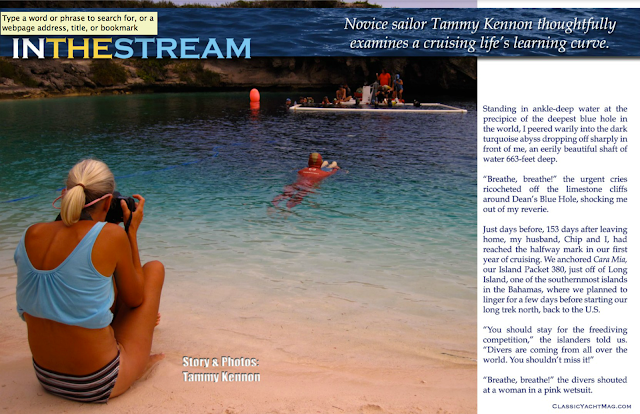
CLASSIC YACHT: THE SIMPLEST REMINDER


"This tiny island was proof that dreams are not granted based on gender or youth but rather on the tenacity of your spirit and the strength of your grasp."
If you're new around here, you might not know about my obsession with freediving. We happened upon a world competition in the Bahamas our first year of cruising. At the time, I wrote an article about it that was published in the New York Times.

Now I've written about it in my column (PDF version) in the November/December issue of Classic Yacht magazine. This is a much more personal account of watching Natalia Molchanova, a Russian freediver, attempting to set a world record. But at its heart, it is about reaching just beyond your grasp.

If you catch the bug too, see more of my freediving world here:

The awesome Women of Freediving.
Photos of Dean's Blue Hole.
Thoughts on the sport of Freediving.
My Freediving Board on Pinterest where I post all the latest news and videos from the freedivingsphere.

Wednesday, April 20, 2011

FREE OF FREEDIVING

Salt Pond, Long Island, Bahamas 23º21.4N | 75º8.23W

Simon flashing the crowd.   Photo by Chip 
Our freediving frenzy is over. The competition ended yesterday leaving a heavy brush stroke in the record books and an indelible mark in the scrapbook of our cruising. These athletes set 11 national and 2 world records in 10 days, and in that time, we came to admire and befriend many of them.

It should be noted that I have neglected the men of freediving in this blog, although not in the 'official' printed article, so here's a quick look.

I was charmed by Simon, the half Brit, half Chilean diver who clomped around in purple Crocs when he wasn't setting record after record for Chile. This "snorkeler who goes deeper" is the father of three boys and is brimming with wit and good cheer.

Simon
And there was the clear ladies' favorite, Igor, the gregarious and flirtatious bar owner from Switzerland. I hope we get to belly up to his bar one day for a nice, cold draught and a good, long chat.

Igor
Jyri, a programmer from Finland took a lot of grief for his flowered floaty used during his breathing period before diving. "I was really nervous today, because I wasn't nervous," he told me.

Jyri and his flowered floaty.
And, of course, William Trubridge, the ninja of freediving, the lanky, quiet one who organized this competition and continues to push the limits of his sport, seemingly effortlessly. He told me there are no limits to his sport. In that moment, I believed him.

Trubridge.
The competition is over, and my work here is done. We will soon be pointing Cara Mia's bow north, across the Tropic of Cancer with our first stop back in Georgetown for the Bahamas national regatta where we will meet our friend John from D.C. -- with Jessie Marie, freshly returned from a sail to the Jumentos.

Good times past. Good times ahead.


More on Freediving and Dean's Blue Hole:
My photos of Dean's Blue Hole.
My thoughts on Dean's Blue Hole.
The Women of Freediving
My article about Freediving in the New York Times.
My Freediving Board on PInterest.


Igor photographing the ladies.
Simon's Crocs.
No caption needed.  
Photo by my hitchhiking, lunch-making, gear-carrying reporter's assistant.

Sunday, April 17, 2011

BUY A NEW YORK TIMES TODAY ...

... to read why I haven't been blogging.

Natalia Molchanova preparing for one of several attempts at a world record,
a hurdle she finally cleared just yesterday.   Photo by Chip Sellarole
We stumbled upon Vertical Blue 2011, a freediving competition, while visiting Dean's Blue Hole in Long Island, Bahamas, and fell under the spell of this dramatic sport -- in an equally dramatic location. I'll write much more about it soon, as well as filling in the missing blogs, so keep scrolling down in the next few weeks.

My article about freediving is in the New York Times today, in the Sports section.

Let me know how the print edition looks. How funny that I'm in 'Long Island' yet the NYT is not sold here.

A deep water thanks to my old friend Jeffrey Marcus at the New York Times for being my guide rope and to my new friend DeeDee Flores for the spectacular underwater shot.

THE WOMEN OF FREEDIVING

Salt Pond, Long Island, Bahamas 23º21.4N | 75º8.23W

Interviewing Junko.     Photo by Chip
Sweet and gentle Junko, the Japanese freediver at this competition, quit her job as an account manager to give herself time off to pursue her passion of freediving. This is her first competition in a year, and, wait for this: she had brain surgery 6 months ago. When I asked how her first 50-meter dive since brain surgery went, she merely shrugged her shoulders, put her hand on the side of her head, and said, "It feels like it's okay."

Junko was the first female diver I interviewed, and I was surprised, shocked really, to find out she is 42. Then I met the other women in this competition.

Carla demonstrating the only thing that kept her from a national record.
Carla Hanson, the lone U.S. diver at Vertical Blue 2011, is 55. She has her own visual design firm and has been freediving for only two years. In her younger years she hovered on the surface as a competitive swimmer and at one time held the women's butterfly world record. During this competition, Carla doggedly attempted five times to set the national record in freediving with no fins. On her closest attempt, she successfully reached her depth but was unable to rally at the surface to complete the three simple steps to prove lucidity: remove your face gear (goggles, nose clip), say, "I'm okay," and make the okay symbol with your hand. That little hand signal was all that stood between Carla and her national record.

I could go on and on. These are inspiring and colorful women. There is Lena, the 33-year-old former actress from Serbia, Linden, the professional, freediving mermaid, who serves as a judge, and DeeDee, the self-proclaimed "shemale" in gender "transition," a standup comedian and freediving underwater photographer. And then there is the ultimate freediving goddess:

Natalia Molchanova.
The indomitable, intimidating Natalia Molchanova from Russia came to Dean's Blue Hole on a mission: to seize the only women's competitive freediving world record that she doesn't already hold, a record she set last year but then lost later to a judging technicality.

In a sport of mind over, well, everything, where the brain must override utter panic and the body's belief that death is imminent, Natalia is a champion. When she dons her wetsuit and enters the water, her unshakeable focus is so intense, it's as if she has stepped into another dimension. Even though I could see her, it seemed to me she had gone so far into another place that she couldn't see back.

Natalia in her other realm. That's her lying on the surface in a pink wetsuit,
with her head resting on a yellow noodle swimming toy, preparing to enter the abyss.
On the first day of competition she went right for that world record, no messing around, making her depth of a stunning 103 meters -- that's 338(ish) feet, more than a football field down -- then the same distance back up, all on one breath.

On her way to the surface, she suffered a frightening (to me) blackout well below the surface and had to be ferried up by safety divers who then shouted at her, "breathe, breathe, breathe!"

Natalia Molchanova, center, returning to us from the abyss.
Undaunted, Natalia, the aquatic bulldog, kept at it, three days, always making her depth and then blacking out, although after the first day, the blackouts were at the surface and less frightening to us as spectators.

Today, on the seventh day of the competition, she donned her old, thicker wetsuit, dove to 100 meters successfully retrieving the tag, just as she had done on the previous three attempts. (Although this was three meters less than the first day, it was still enough to set the world record.)

We all waited at the surface for an astonishing 3 minutes and 42 seconds as Natalia fought the demons of the underworld.

"10 meters. 8 meters. 5 meters," the announcer called out as she approached the surface, all of us holding our breath, or at least I know I was.

She came blasting out of the water, and with the 15-second clock ticking, removed her face gear, gave the hand signal and said, "I'm okay." The judge flashed a white card giving Natalia every world record in women's competitive freediving -- at 48 years old.

The press box of one, gasped for air, and the crowd went wild.

Lena, the lovely and perpetually happy Serbian actress, who turned back
early on her dive one day, because "there were demons down there."
DeeDee, the spectacular.
Natalia Molchanova after her world record dive and the professional
mermaid judge flashing the white card, symbol of a successful dive.
And then everyone lined up for a photo with the champion of the deep.

p.s. -- There were some men at the competition as well. And my article about freediving was published in the New York Times Sunday edition with a photo by the fabulous DeeDee Flores.


More on Freediving and Dean's Blue Hole:

My photos of Dean's Blue Hole.
Thoughts on Freediving.
Freediving Board on Pinterest.
My column about Freediving in Classic Yacht.

who are these people? me | chip | cara mia | my column |
 | my pre-cruising blog | contact me |

Wednesday, April 13, 2011

FREEDIVING: A CURIOUS SPORT, INDEED

Salt Pond, Long Island, Bahamas 23º21.4N | 75º8.23W


There are so many fascinating and unexpected things about freediving, I hardly know where to start. I'm tempted to say something trite like 'there are no words to describe,' but I'm a writer, and that would be improper, if not a relief. There's enough material, enough words for an entire book, but let's try to keep it to a pamphlet.

The mechanics of freediving is fairly straightforward. The athlete dives on a single breath -- without breathing apparatus, retrieves a tag from a metal plate suspended by a rope (like some video game, huh?) and resurfaces.

Now the curiosities begin.

Just about everything I imagined about freediving turns out to be wrong. In this sport where the athletes try to dive deeper and ever deeper, I thought that surely the dangers were deep in the abyss but most of the dangers are at the surface at the end of their breath and body's capacity. Divers often black out from lack of oxygen to the brain, kind of like standing up too fast.

I never imagined the chemical and physiological turmoil that's playing mischief on a diver's body.

The most immediate effect is from pressure. Every 33 feet of depth in the water is equal to the total pressure on our bodies at the surface, so, in effect diving 33 feet doubles the pressure and subsequent compression on the body. Since these divers go down incredibly deep, some more than 300 feet, you can do the math. The pressure is immense, a tighter and tighter bear hug over the entire body.

This intense pressure is felt in air cavities in the head and chest as the air gets compressed and the cavities start collapsing. One diver demonstrated this to me by forcing out all of the air in his chest. I watched in distress as his chest caved in more and more, his ribs protruded. Gross.

They experience great pain in their ears, like we do in a small way when descending in an airplane. The divers have to learn tricks for equalizing this pressure, forcing air into their ears lest the eardrums rupture. The compression around the neck is so intense that merely turning the head suddenly or looking up can cause injury, so on the ascent and descent, divers don't stretch the neck by looking where they're going.

I really thought that breathholding would be a great challenge for these athletes, but it turns out, breathholding is a skill somewhat methodically learned. It's not breathing out that's the problem. Gasses in the body that are usually expelled without incident get forced into the bloodstream and wreak total havoc on the body and mind. Divers experience what they call deep water narcosis, causing profound panic and at the same time limiting motor skills. They hallucinate. Several divers told me that during narcosis they can't tell if their eyes are open or closed; they see the same thing either way.

To state the obvious, these toxic gasses cause some issues, leading to another contradiction. Those three simple steps they have to perform on resurfacing may sound just plain silly, something a 3-year-old could perform, but for someone returning from the abyss, trying to equalize pressure, breathe and shake off narcosis, those simple actions can seem impossible.

So, let's recap. A diver drops into a dark abyss, blindly freefalling, feeling more and more extreme pressure collapsing the body, increasingly experiencing utter panic, hallucinations and limited ability to move the arms and legs. And that's only the descent. Now they must turn around and swim all the way to the surface.

I really believed that in addition to being a mentally challenging pursuit that this was a dangerous, even treacherous sport. Seriously, I thought I might see someone die at this competition, but guess what? In the greatest contradiction of all, it's not all that dangerous -- especially the three types of freediving being practiced at this competition, the three more 'pure' disciplines without the use of mechanical propulsion for ascent or descent. Most of the notorious deaths in freediving have been in the disciplines where divers use mechanical sleds to pull them down and back up. When those sleds malfunction, well, yeah.

The diver (right) goes toward the light.     Photo by Chip
Failure in this type of pure, self-propelled freediving doesn't mean death and usually not even injury. There are a lot of safety measures in place to protect the divers, including ultimately, the deployment of a platform that will bring them to the surface if they have trouble beyond the reach of safety divers.

At this Vertical Blue competition, spectators can swim right up within a few feet of the dive platform to watch the action. It is just impossible to watch this close without being moved, I mean like emotional, tear inducing kind of moved.

Dean's Blue Hole, as I've already written, is awe-inspiring on its own, in the old sense of awesomeness before awesome came to describe a cute pair of earrings as opposed to, say, witnessing a volcano eruption. This crystal clear, turquoise void draws us little humans like a black hole, only this one is blue.

Then watching these folks vanish down into it, you just think science fiction, a transporter, a chute to another dimension, a portal to, um, somewhere else.

I would just hang on the PVC pipe barrier and peer down in wonderment as a diver faded into the cold blue darkness, watching, watching, watching, waiting the long minutes that seemed like eternity for them to please return to us, to our realm of air and sunlight.

The diver comes bursting out in an electrifying moment, face sunken, eyes not quite sentient, like a newborn baby popping out of the womb, water dripping, primal instinct trying to force nerve and muscle to suck in air, to leave the fluid darkness behind and exchange the sustenance of fluid for that of air.

As I watch this crazy birthing or in another contradiction, perhaps a near death experience, I alternately hold my breath and gasp for air, willing the diver to pass through the gateway between the underworld and our own.

I know, such melodrama, but truly, that's how it feels. So often in those 15 seconds of transition when the diver was coming back to us, I teared up, filled with utter elation when the life behind their eyes returned, when they spoke those simple words, "I'm okay."

Chip asked a friend of ours who is an anesthesiologist if there's really some life and death experience there, if the chemical reaction going on is akin to what happens at death.

It seems the answer lies somewhere in that sketchy and tumultuous zone where science ends and spiritual belief begins.

The freediving zone.


More on Freediving and Dean's Blue Hole:
My photos of Dean's Blue Hole.
My thoughts on Dean's Blue Hole.
The Women of Freediving

My article about Freediving in the New York Times.
My Freediving Board on PInterest.

Sunday, April 10, 2011

THE RIDES

Salt Pond, Long Island, Bahamas 23º21.4N | 75º8.23W

Chip surviving a high speed ride in a pickup bed.
As Americans, we are just naturally averse to hitchhiking, certain we'll be kidnapped, tied up in a damp basement and/or just plain disappeared. But we're on Long Island in the Bahamas, where hitching is just offering locals a chance to say hi.

Every day, with Chip (the best reporter's assistant in the world), I hitchhike 20 miles from our boat to Dean's Blue Hole -- and back -- to work on my article about freediving. We average three rides each way. If the folks here can't pick us up, they stop to apologize and explain why.

"Sorry. I'm turning off at the next street."

"Oh, I'm only going up here to the liquor store! I'm sure someone will be along soon."

Others take us part way and then wave down relatives to take us the rest of the way. A few have driven several miles off their path to make sure we get to our destination.

Dean's Blue Hole is a good mile off the highway down a sandy road. Every day we've been delivered all the way down the road, right to the edge of the blue hole.

"I'm not supposed to take riders, but my boss is on the other end of the island," the guy from the power company told us.

He laughed as he talked about his rambunctious 5-year-old son. He cried as he told us about his 8-year-old daughter who can't walk and barely talks because of a genetic disorder. We cried a little too.

Later that day, our same power company friend picked us up once again. Old friend.

A regatta boat builder and captain took us to see Rupert's Legend, a four-time winner of the national regatta, where we chatted with Edsel, one of the owners, and his daughter Savannah.

"Are you gonna help your dad sand the boat?" I asked Savannah.

"No," she said emphatically.

"What if he changed the name to Savannah?"

"YES!" she said in a hell-yes sort of way.

Rupert's Legend getting new paint for the regatta.
We rode in rusty, rickety compact cars, souped up pickups, tricked out SUVs, family sedans, working vehicles, everything. We met fishermen, government workers, chauffeur moms and real estate developers. We shared laughter, tears and stories.

The only common thread running through the diverse bunch of drivers is their pride in this beautiful island of theirs and how very glad they are that we stopped by to see it.

Friday, April 1, 2011

BITTEN

Salt Pond, Long Island, Bahamas 23º16.7N | 75º6.9W

A freediver waits on the dive platform at Dean's Blue Hole.
An exotic location, death-defying action, mystery and intrigue. It's not an Indiana Jones movie, it's a sports competition.

Next week, divers are converging at Dean's Blue Hole here in Long Island for a competition, where they will attempt to set and break world records for diving as deep as possible on a single breath. And I don't mean 30 feet. We're talking hundreds of feet down -- and then back up, dives that last two, three, four minutes.

I expected to be interested in the competition. I did not expect to get bitten hard by the journalism bug. I thought I had long since developed an immunity to that particular news bug, but this story has captivated me. So I've pitched it, literally thrown it out there to see if I can sell the concept.

And so we wait.

For word. For the competition.

In paradise.

Monday, March 28, 2011

SIGHTS OF DEAN'S BLUE HOLE

Salt Pond, Long Island, Bahamas 23º16.7N | 75º6.9W
A tree growing on the edge of Dean's Blue Hole.

Karen coming out of the abyss.  Photo by Dale Thomas
Dale going down.   Photo by Chip
What are they doing, and why are they shouting, "BREATHE, BREATHE!"


My thoughts on Dean's Blue Hole.
My thoughts on Freediving.
My article about Freediving in the New York Times.

Sunday, March 27, 2011

BLUE OR BLACK?

Salt Pond, Long Island, Bahamas 23º16.7N | 75º6.9W

We drove our rental car down an inauspicious sand road, past an unassuming, handpainted sign that said simply:
DEANS BLUE HOLE 
TURN HERE


At the end of the road, we walked down a white sand path and into ....

Dean's Blue Hole.
Here are the facts: A blue hole is a vertical cave filled with water, or, in this case seawater. Dean's Blue Hole is circular at the surface about 100 feet in diameter, surrounded by shallow -- really shallow water -- and plummeting sharply to 663 feet at its center. Above water it is protected on three sides by craggy limestone cliffs and rocky hills. About 66 feet below the surface, it widens into an underwater cavern over 300 feet wide.

As usual the facts don't tell the story -- at all.

Here is the story: This place is magical, capturing the imagination, tripping the senses and tweaking the intellect. Science fiction has had its way with black holes but has clearly overlooked the blue ones. Standing on the precipice in six inches of water, you lean over and peer into the abyss, equal measures of horror and seduction twanging your nerves.


Am I peering into a simple vertical cave of water or is this a portal, a magical transporter into the aquatic world? If I plunge in will I follow the wake of the incredible Mr. Limpet, become a mermaid, a dolphin, a citizen of the deep, or just sink right to the bottom? Can I bear not knowing?


More of my photos of Dean's Blue Hole.
Thoughts on Freediving.
My article about Freediving in the New York Times.